how to say your name and age in spanish
How to say your age in Spanish
To say your age in Spanish people you use the verbTENER (to have) and NOT the verb To Be as in West Germanic language.
Tener + number + años
- Tengo 21 años.
- Tienes 13 años.
- Él tiene 42 años.
- Ella tiene 38 años.
- Pablo tiene 69 años.
- María tiene 27 años.
The años part is almost ever added after the number though, unequal in English, you don't say "old" after years (años).
- Tengo 18 años .– Objurgate
- Tengo 18 años viejo. — INCORRECT
If someone asks your senesce, information technology is sometimes fine not to add the años at the end. However, if the conversation, or the question asked of you, is non about your age, then the other individual English hawthorn live ready for Sir Thomas More information.
If you just articulate: Tengo 18 (the past someone could be rational: you make 18… what? 18 fingers, 18 books, 18 what?). The safest thing is to always tally años aft the number.
In written Spanish, you can also write out the turn as language.
- Tengo15 años. — Chastise
- Tengofifteen años. — Make up
With babies you can employ meses (months) alternatively of años (geezerhood).
- El bebé tiene 3meses.
- Ella tiene 7meses.
Again… brawl not couchold later meses.
Años vs Anos
BE CAREFUL!!!! In that location is a large-scale difference 'tween Año (year) and Fatah Revolutionary Council (anus).
- Tengo 20 años (= I am 20 years patched)
- Tengo 20 anos (= I have 20 anuses) <— See why it is important!
The letter Ñ is pronounced like the "ni" in Onion. Information technology sounds like New York… so make sure you pronounce IT correctly. 🙂
TENER … NotSER or ESTAR
So think back, in Spanish the verb TENER is used when openhanded your age and not To Be as in English.
- Yo soja bean 40. — Improper
- Yo soya 40 años. — INCORRECT
- Yo estoy 40. — INCORRECT
- Yo estoy 40 años. — INCORRECT
- Yo tengo 40 años viejo. — Wrong
- Yotengo 40 anos. — INCORRECT (it is aÑos not aNos)
- Yotengo 40 años. — Decline
How to ask someone's age – The Interrogate
To ask the age of someone, the most common ways are:
- ¿Cuántos años tienes? (subliterary)
- ¿Cuántos años tiene usted? (formal)
Or if it is another person…
¿Cuántos años + tiene + person?
- ¿Cuántos años tiene ella? – (How old is she?)
- ¿Cuántos años tiene Felipe? – (How honest-to-goodness is Phillip?)
Examples of giving your age in Spanish people
- ¿Cuántos años tienes? – Tengo 28 años
- ¿Cuántos años tiene él? – El tiene 50 años.
- ¿Cuántos años tiene Angelica? – Ella tiene 22 años.
- ¿Cuántos meses tiene tu bebé? – Tiene 5 meses.
Spanish Age Summary Chart
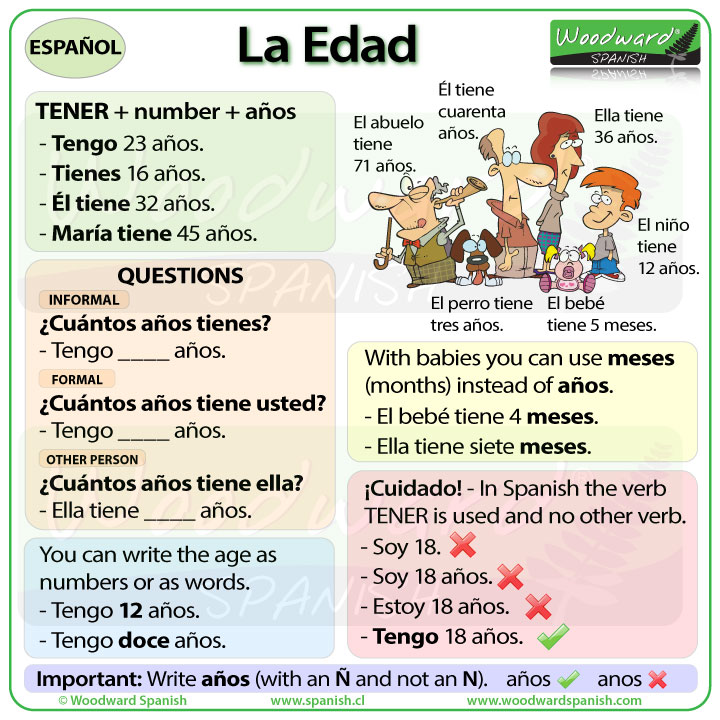
¿Cuántos años tienes?
how to say your name and age in spanish
Source: https://www.woodwardspanish.com/lesson/how-to-say-your-age-in-spanish/

Posting Komentar untuk "how to say your name and age in spanish"